Vibe coding for senior software engineers
All of a sudden, everybody is talking about how great vibe coding is. Well, what is actually surprising is that, this time, real experienced software engineers are talking about how GPT-5.2 and Claude 4.5 change the game.
I think it all began with this tweet by Andrej Karpathy:
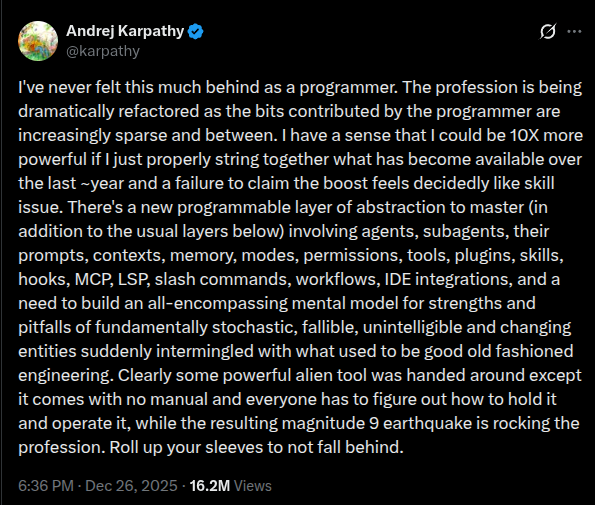
After that, some notable Software Engineer influencers (I think the term is accurate, but I can’t make it sound serious in my mind when I read it) published messages giving vibe coding a positive spin, like The Primeagen, The Pragmatic Engineer, or Jaana Dogan (I don’t know how well this last post was received inside the Gemini team).
I’ve been reading quite a lot about people using this new vibe approach to software engineering, and people’s preferences seem to be split between GPT-5.2 and Claude 4.5, with only a few cases of people preferring Gemini. Among the most interesting reads I’ve found, there is this thread from Claude Code creator Boris Cherny, or this article by Peter Steinberger, which I found linked by Andrej Karpathy on Twitter.
New tools for new engineering practices
Last year was the year of the AI IDEs and web tools, like Cursor, Lovable, v0, and others. But the focus now is on these command-line tools that emphasize the autonomy of the agents.
They are not apps where you are assisted by an LLM. Rather, they are interfaces through which you can communicate with a coding agent (or several). The difference is subtle but important: the user takes the seat of the ship’s captain, while Codex or Claude takes the role of the rest of the officers on the ship’s deck.

So now I want to vibe-code a new project and write a blog post about the process. But while thinking about it, trying to locate some old Codex prompts, I realized there is no easy way (that I know of) to list all the Codex prompts in your system. You can use codex resume to show a list of Codex sessions in a given folder/repo, so you can select one and see its contents and keep working with the same context:
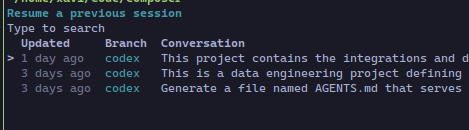
but I didn’t find a command to list all the sessions in your system, despite Codex storing all the session logs in the same folder by default ($HOME/.codex/sessions).
So I decided to make a quick vibe-coding test! I used Codex for the first version, Gemini to make a first refactor, Claude Code for final details and debugging. I spent about an hour doing it, mostly prompting specifics about paths, dealing with edge cases, etc. Well, actually, I spent most of the time waiting, because each task took a few minutes to complete. This is an important point: I tend to lose focus easily, and if I start browsing the web or reading articles while I wait, I don’t realize that the agents have ended their tasks. This gave me two important lessons:
- Enable notifications from the agents! (obvious, but not trivial with my setup)
- Plan the work in parallel chunks: try to have several different agents working on different parts of the application, or on different applications.
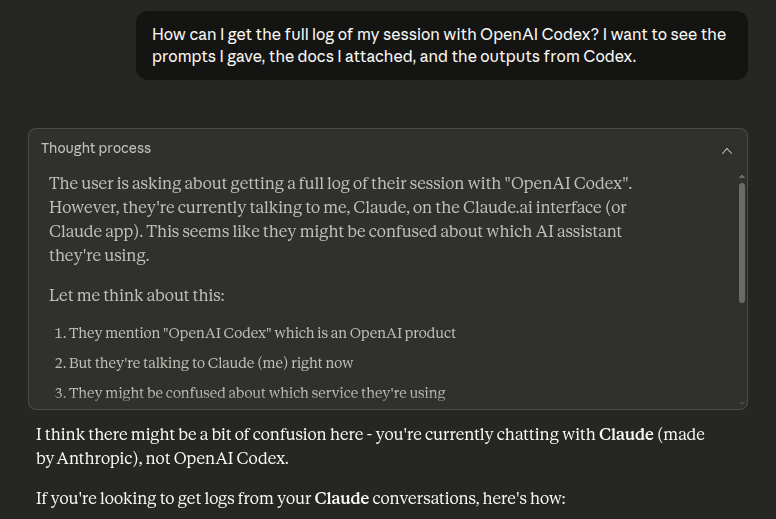
The result
The resulting code is in this repo. Not the most elegant piece of code ever, but it works.